
When Everything Becomes Abundant, Eventually Nothing Is
Abundance and Scarcity in the Age of AI

Living in the age of Generative AI is both exhilarating and exhausting. One year feels more like five. Tools, benchmarks, and paradigms shift so rapidly that trying to keep up feels like chasing a runaway bullet train. We happen to live during one of the most consequential inflection points in human history. But is this shock entirely new? Have we lived through this dynamic before? What can history teach us about surviving a sudden explosion of abundance, and what happens to the things that used to be scarce?
How Did We Get Here?
The Agricultural Revolution gave us a reliable, predictable source of food. Surplus grain required protection, which led to communities gathering into tighter spaces. As early defense structures were built, the need for civil organization grew. As our coordination grew more sophisticated, human settlements became more efficient. Villages turned into cities, cities became kingdoms, and kingdoms expanded into empires. Progress turned exponential. Around five hundred years ago, the Scientific Revolution dismantled our primitive assumptions about the cosmos. Mathematics and empirical inquiry turned our understanding upside down. The steam engine kick-started the Industrial Revolution, laying the foundation for modern civilization and multiplying human productivity by orders of magnitude.
The cycles only accelerated. The room-sized computer of the mid-twentieth century shrank into the desktop PC and eventually the smartphone in our pockets. This was quickly followed by the rise of the internet, which fueled the information era and shaped the connected globe we inhabit today. Before the dust from the digital age could even settle, the Generative AI wave broke in late 2022 with the public arrival of ChatGPT. In a flash, we stepped from the age of information into the age of machine intelligence.
Each of these leaps followed a brutal, recurring economic pattern. Every revolution devalued exactly what the previous era treated as precious, and manufactured a brand-new scarcity no one predicted.
Consider the Industrial Revolution. For thousands of years, human physical strength and generational artisanal craft were the primary drivers of material wealth. If you were a master weaver, your trade was your fortress. Then the steam engine arrived. A single mechanized loom could produce more yardage in an afternoon than an artisan could weave in a month. When the Luddites smashed mechanical looms between 1811 and 1816, they were not naive technophobes terrified of machinery. They were skilled laborers whose hard-won status, dignity, and economic leverage were being erased overnight. Physical muscle stopped being scarce, and its market value collapsed. What became scarce instead was capital, machine design, logistics, and organizational management.
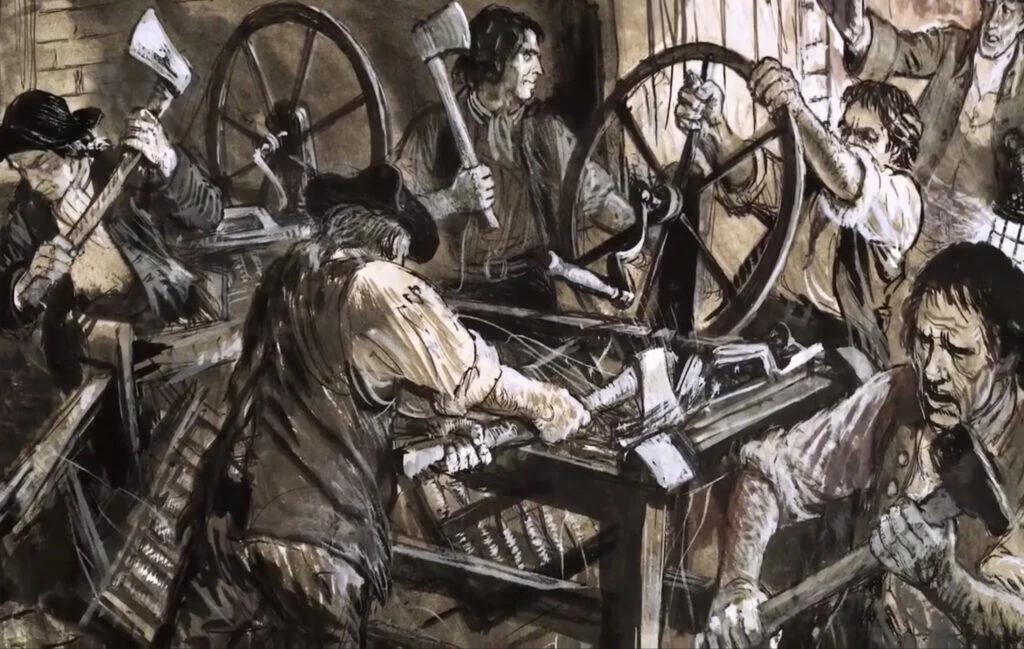
Luddites Smashing the Machines of the Industrial Revolution. Source: Giclee Print by Cl Doughty.
The internet repeated the script. For centuries, information was scarce, locked behind the gates of prestigious libraries, expensive encyclopedias, and academic gatekeepers. If you held proprietary knowledge, you held power. The internet broke that monopoly by dropping the marginal cost of copying and distributing information to zero. Yet making information infinite did not create an enlightened utopia. Instead, as economist Herbert Simon anticipated decades earlier, a wealth of information created a poverty of attention. When answers are everywhere, the bottleneck is no longer access to data. The scarce commodity becomes focus, taste, discernment, and the ability to filter signal from endless noise.
Now, Generative AI is doing to cognitive work what steam did to muscle, and the web did to distribution. Drafting readable prose, generating functional code, summarizing dense reports, creating illustrations, or analyzing financial statements once demanded years of specialized training and intense mental exertion. Today, synthetic cognition is on tap for pennies per million tokens. The raw ability to produce answers and execute logic is being commodified at breakneck speed.
So what comes next when raw cognitive output ceases to be scarce?
As Alexandr Wang puts it:
"In a decade, looking back, it'll be obvious that intelligence became abundant and agency became abundant. Throughout human history, groups of smart people coming together toward a shared goal have been the bottleneck of progress. And that's going to change; all of a sudden, the scarce resource isn't intelligence or agency, but vision and ambition. What is the one way you want to put your finger on the scale for how the world will develop and what it will look like in 5 to 10 years? And do you have the ambition and drive to go through it to make that happen? AI will make that easier by 10 or 100 times compared to a decade ago, but the flip side is that you can now dream bigger."
What Can We Learn from the Past?
We can look at our present in 4K with high-fidelity color and spatial audio. A couple of generations earlier, the world was just black and white. A few generations before that, we saw our ancestors through blurred photographs. If we look further back, oil paintings and crumbling manuscripts are our only window into human life. Only twenty generations ago, written knowledge was so precious that every page of every book had to be painstakingly copied by hand by scribes working under candlelight.

Jean Miélot, a European author and scribe at work. Source: Wikipedia
Every step of human history has been an effort to improve the human condition by optimizing for efficiency and building better tools. One recurring pattern across all of these transitions is that they happened gradually, and then suddenly.
Curiosity, collective consciousness, and agency are etched into our DNA. We accumulate knowledge, refine it, and manipulate it to reshape our environment. But there is too much to learn. Because no single lifetime can hold all human knowledge, we pass down accumulated wisdom across generations. Most of the time, progress crawls forward through small, incremental improvements. Then, every once in a while, someone comes along and suddenly discovers a paradigm shift that changes everything, proving that modern science is built quite literally on the shoulders of giants.
If I have seen further, it is by standing on the shoulder's of giants.
~ Isaac Newton
Yet every time we engineer abundance, we run straight into our own contradictions. In the nineteenth century, economist William Stanley Jevons noticed a strange paradox. As technological improvements made steam engines more efficient at burning coal, Britain did not burn less coal. It burned exponentially more because the lower cost opened up vastly more uses for it. Abundance never reduces our appetite. It multiplies our consumption until we hit an entirely new barrier.
In 1930, John Maynard Keynes published his famous essay, Economic Possibilities for Our Grandchildren. He predicted that within a century, compound technological and capital growth would solve the primary economic problem, leaving society with a fifteen-hour workweek. The abundance Keynes foresaw arrived in full force, yet the leisure never followed. Why? Because human desire is positional. We do not merely consume goods to survive; we consume status, distinction, and rank.
As William Morris warned during the height of Victorian industrialization, an abundance of goods has never guaranteed an abundance of the good life. When a resource becomes frictionless, we tend to drown in it rather than be liberated by it.
Is AI Actually Intelligent?
Put me in a locked room, and I would scream, "Let me out! Let me out!" Put an LLM in a server rack, and it would respond, "Hello, how can I help you today?"
Whatever this technology is, it is not sentience, and it possesses no soul. But what does that even mean? Is a soul required for utility or intelligence? LLMs speak our natural languages instead of raw binary or abstract symbols because we trained them on millions of pages of human expression developed over millennia. Is language the root driver of intelligence, or simply a vehicle for it? Would a chimp become fundamentally intelligent if it could speak fluent English, or did our ancestors start speaking because they were inherently intelligent? Social intelligence came first. Language emerged as a byproduct, a tool invented to share intent, just as millennia later we invented the abacus and the calculator to do arithmetic.

Ancient language carved into walls before written language was invented. Source: Unsplash
If intelligence means learning from mistakes to discover the most elegant path to a solution, a modern LLM is astonishing, but efficient it is not. At least not yet.
Today, if I were to ask an AI-powered robot to pass me the water bottle on the table, circling around the living room twenty times, knocking over a lamp or two and bumping into every cupboard on its path, before finding the bottle to finally drop it to the ground, trying to grab it at a weird angle, is not intelligence; it is brute force. While this is a hypothetical scenario to highlight the entropy problem of current LLMs, it emphasises the risk of treating the LLM as a universal hammer, eagerly swinging it at every nail we can find.
The recent milestone from OpenAI, where an agent swarm produced a candidate solution for the Navier-Stokes Millennium Prize problem, captures this dynamic perfectly. By deploying roughly ten thousand concurrent agents exchanging millions of messages, they reportedly spent $15 million worth of compute, burning through an estimated 130 billion tokens, to attack a problem with a $1 million bounty.
The potential here is undeniable. The human mind is no longer the sole entity capable of making headway into the deepest frontiers of mathematics. But the contrast is stark. When Grigori Perelman cracked one of the Millennium Prize problems, the Poincaré conjecture, he worked quietly with pencil, paper, and profound geometric intuition. OpenAI solved Navier-Stokes by setting an entire data center on fire. Compute can brute-force brilliance, but entropy always demands its tax.
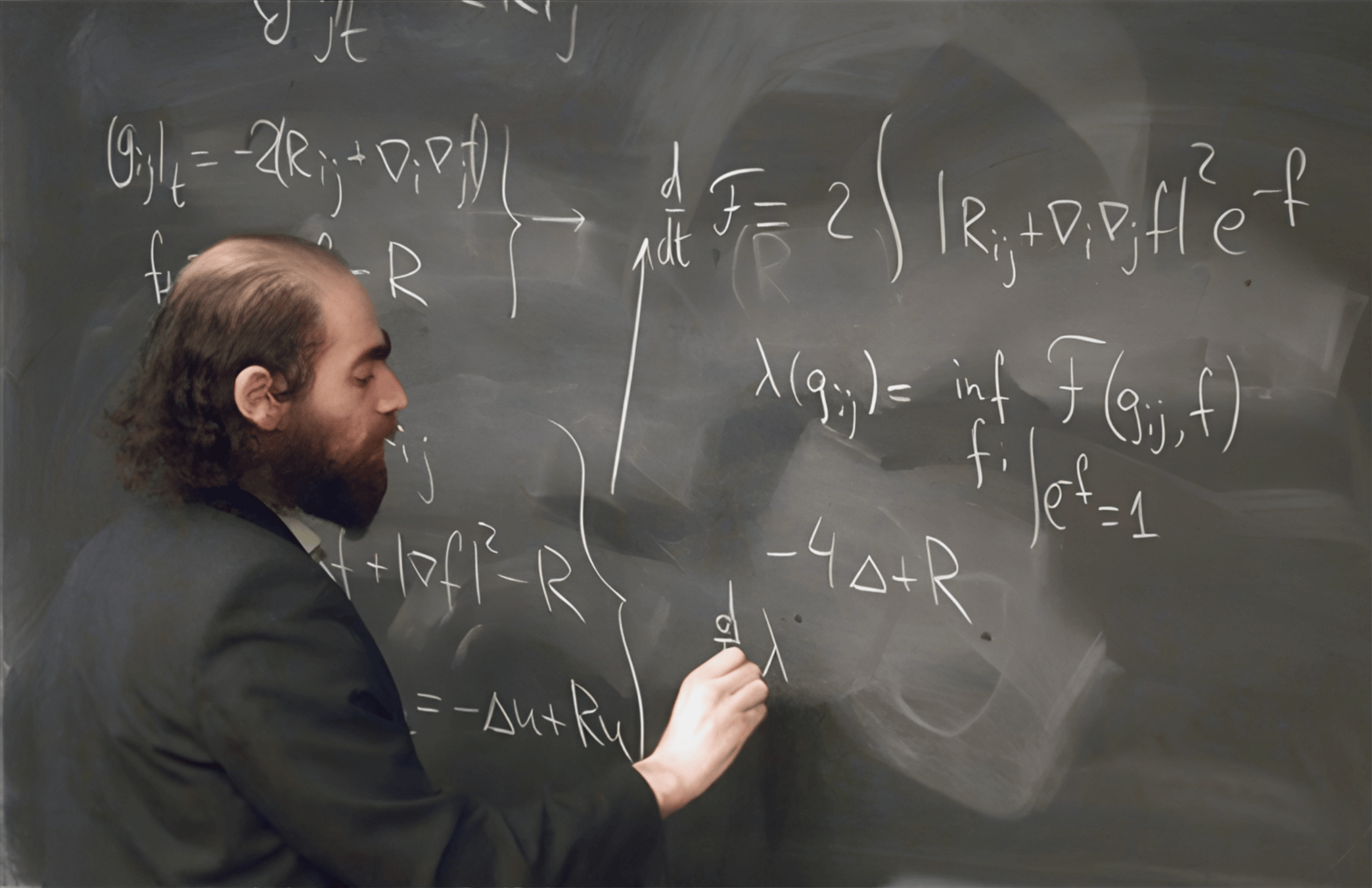
Grigori Perelman, solver of Poincare's Conjecture, gives a lecture on his solution. Credit: Frances M. Roberts
Everybody understood that if the proof is correct then no other recognition is needed.
~ Grigori Perelman
Where Are We Headed?
For now, humans work alongside AI to solve problems, but how long will that be the case? Abundance of goods has never guaranteed an abundance of the good life. What will be the truly scarce abilities to possess in a post-AI world where billions of people need a livelihood and a reason to wake up in the morning? Will meaning become the last scarcity?
The New Scarcities: Trust, Effort, and the Vanishing Junior
When synthetic content becomes infinite, value migrates to whatever cannot be replicated with a prompt.
Trust and Provenance
When any voice can be cloned, any face animated, and any argument drafted in milliseconds, convincing evidence of reality becomes the rarest commodity. The scarcity is no longer the text or the pixels; it is the verifiable guarantee that a living human stands behind them. This is why the term "AI slop" emerged as a slang for any AI-generated content without authenticity. We will see the emergence of cryptographic provenance and human-origin certification as standard practice. In the same way the industrialization of factory food created an enduring, high-margin market for organic goods, an internet saturated with synthetic content will make human-verified creation a luxury tier.
Effort as a Signal
In human relationships, effort has always been the primary vehicle of sincerity. A handwritten letter or an artisanal gift carries emotional weight precisely because it costs someone their finite, irreplaceable time. If a deeply empathetic condolence note or an eloquent cover letter can be generated in three seconds, the gesture ceases to signal care. When effort drops to zero, the emotional value drops with it.
The Vanishing Junior
This is the sharpest practical crisis facing knowledge work. If autonomous agents handle boilerplate coding, basic contract drafting, preliminary financial modeling, and entry-level research, where do juniors learn the craft? How do you cultivate a senior architect or a seasoned litigator without the crucible of apprenticeship? If companies stop hiring juniors because an AI agent is cheaper and faster today, they are cutting down the orchard to pick the low-hanging fruit.
The Divergence: Leapfrogging or Digital Feudalism?
This transition will not land evenly across the globe. Developing economies stand at a dramatic crossroads.
On one hand, cheap, distributed machine intelligence could become the greatest equalizing force in history. A clinic in a rural district could tap into medical diagnostic intelligence rivaling top research hospitals. A child in an underserved village could learn from a world-class, adaptive tutor speaking their local dialect. Developing nations could leapfrog decades of institutional deficits, much like mobile payments skipped traditional brick-and-mortar banking across Kenya and India.
On the other hand lies the risk of digital feudalism. If the essential cognitive infrastructure, compute clusters, foundational weights, and cutting-edge chip fabs remain consolidated in the hands of a few tech giants, developing nations risk becoming digital colonies. Rather than building domestic capacity, they will pay perpetual economic rent on intelligence itself.
Meanwhile, developed economies face an unprecedented demographic cliff. Birth rates across East Asia, Europe, and North America are dropping well below replacement levels. Some argue that AI automation arrives just in time to cushion the blow of an aging society. But economic output without social vitality is a bleak consolation prize. If younger generations feel economically sidelined, disconnected from ownership and purpose, demographic decline will only accelerate.
The Anatomy of Genuine Optimism
Facing these realities does not require cynicism. It demands clear-eyed resolve.
History reminds us that humanity does not merely submit to technological disruption. We eventually build institutions to tame it. In the wake of the brutal upheavals of nineteenth-century industrialization, society responded not by banning machinery, but by inventing the modern social contract. We established the forty-hour workweek, child labor laws, workplace safety regulations, universal public education, and state pensions. We took an economic system that viewed human beings as raw fuel for factories and forced it to respect human dignity.
The AI era will demand an equally ambitious institutional response. We will need new economic models, such as sovereign compute funds, portable benefits for independent knowledge workers, and serious investments in lifelong human retraining.
The internet of cheap engagement is also nearing its expiration date. For two decades, the digital economy ran on the attention economy extracting clicks, maximizing watch time, and monetizing outrage. Generative AI will break that machine by flooding every digital channel with synthetic noise. When content becomes infinite, nobody will have the appetite to consume algorithmic sludge. The attention economy will collapse under its own weight, paving the way for a trust economy, where value belongs to people and platforms with real skin in the game.
The most promising future is not human replacement; it is human elevation. AI excels at brute force, massive pattern matching, and raw scale. Humans supply intent, taste, moral accountability, and empathy. The master craftsman using machine leverage will consistently outperform the machine operating on its own.
What Remains Scarce
We are erecting an astonishing skyscraper, adding new floors higher into the stratosphere every week. But from where we stand, it is impossible to see clearly whether the structure rests on solid bedrock or on shifting quicksand.
Every revolution in human history made things abundant: calories, manufactured goods, books, electricity, and information. None of them made human lives inherently abundant. They merely shifted the frontier of what we must strive for.
When everything becomes abundant, the only things that retain true value are the things that cannot be synthesized. Our integrity, our courage, our empathy, and the deliberate choices we make about how we treat one another.
In a few generations, when our descendants look back on this frantic, exhausting era, will they look on us with gratitude for the abundant world we built, or will they wonder why we mistook the abundance of everything for the abundance of what actually mattered?
About the author
- Full-stack Developer focused on the intersection of high-performance web and scalable AWS infrastructure. I write Well-Architected to share patterns for building resilient, cost-effective, and developer-friendly cloud-native web applications.
Comments
Join the discussionNo comments yet. Be the first to comment.